
The next handler should know exactly where you left off
Training is the one service where the value lives in the notes. A dog comes back in six weeks, a different handler takes the lead, and everything that made the last session work is in someone's memory or on the back of an intake form.
Pawdentity keeps the program pinned to the dog — sessions, notes, what was worked on, what's left on the package.
Pinned to the dog, ready for whoever has the lead next.
What it doesn't do for trainers.
Training software splits into two camps — curriculum tools and business tools. This is squarely the second one, and the gaps are worth knowing before you look further.
There is no curriculum builder
No skill libraries, no lesson plans, no per-command progress scoring. Session notes are written by a human in their own words, attached to the dog and the visit. If you want a structured syllabus with checkboxes, that's a different product.
Group classes are not rostered as classes
You can run a class as scheduled visits and sell it as a package, but there is no class object with a roster, a waitlist and a term. Trainers running mostly group work in six-week blocks should press on this before committing.
It won't send the homework video
Client messaging and photos are built in; a media library of training content for owners to work through between sessions is not. Most trainers we've talked to keep that where it already is.
The business half of a training operation
The parts that eat an evening every week and quietly lose money when they slip.
Packages that count themselves down
Sell six sessions, and six credits land on the client the moment the order is paid. Every redemption is a ledger entry, credits can carry an expiry, and the balance is the granted total minus what's been used — never a number someone maintains by hand.
Notes that survive a handler change
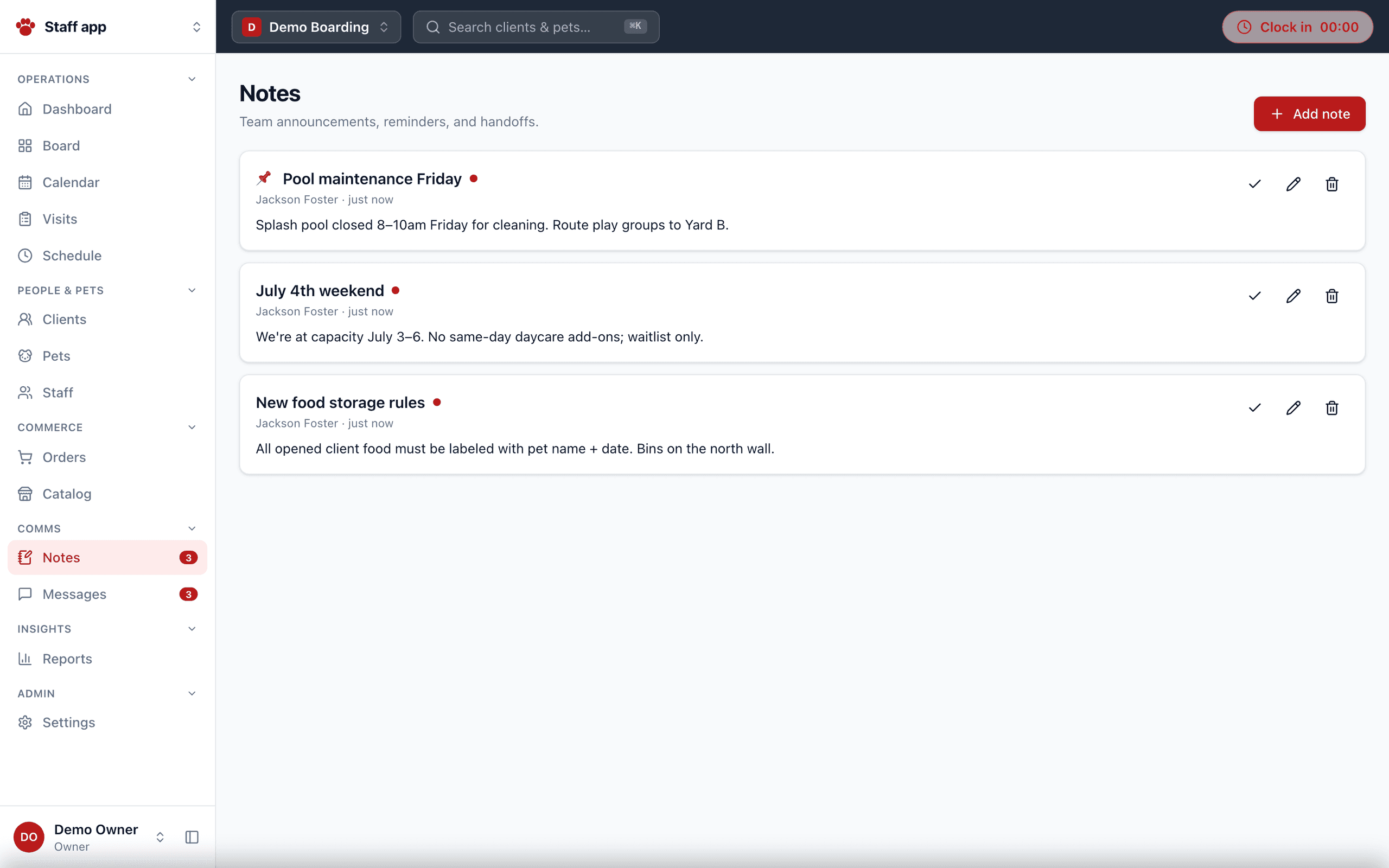
Session notes live on the dog and on the visit, not in a notebook. Whoever takes the lead next opens the pet and reads what actually happened last time — including the things you'd never write on an invoice.
Board-and-train, as one thing
A board-and-train is a stay and a program at the same time, and it usually breaks software that only understands one of those. Here it's a visit that occupies a run, logs feeding and meds like any boarder, and carries its training notes on the same record.
Owners who can see the balance themselves
Clients get a portal showing sessions remaining, upcoming bookings and their history — and they can book the next one against a package credit without asking you how many they have left.
Six sessions sold, five left, and nobody had to remember that
Package credits are issued by the paid order line and redeemed by the booking. The remaining balance is derived, so it can't drift out of step with what the client actually used.
- Credits granted when the package order is paid, not when it's written up
- Every redeem and restore is an append-only ledger entry with who and when
- Optional expiry, computed on read — no nightly job quietly killing balances
- A client can spend a credit themselves when they book in the portal
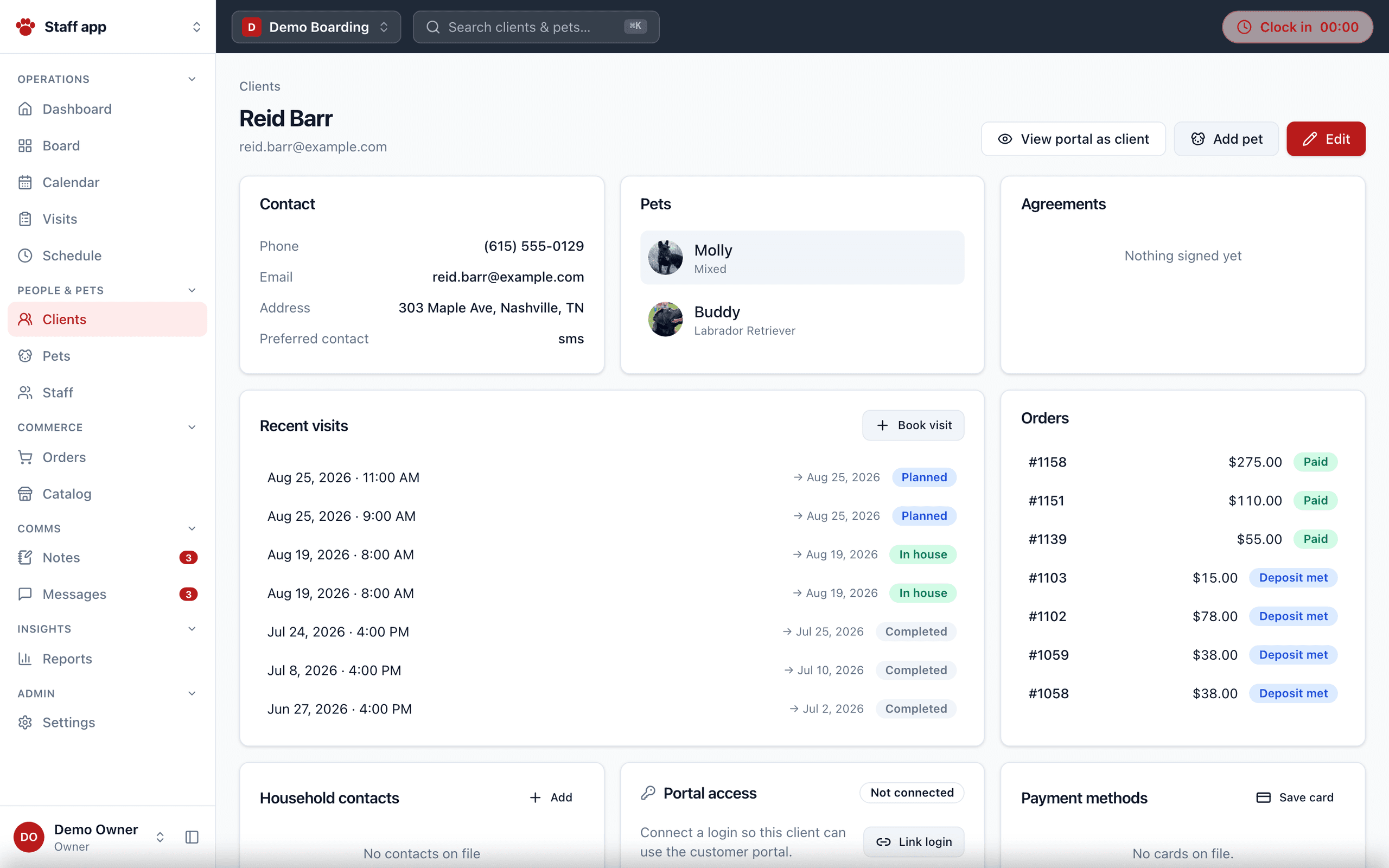
Everything about this dog, in one place a handler can read
Vaccines, feeding, medications, behavior flags, every past visit and every note written on it — the whole history on one screen instead of across three notebooks.
- Notes attributed to the person who wrote them, timestamped
- Behavior and handling flags surfaced before the dog is on the lead
- The full visit timeline, including stays booked for other services
Written up before you've put the lead away
A session note written while it's fresh is worth five typed from memory at nine that night. The whole record works in a browser, so the tablet on the wall and the phone in your pocket are the same screen.
- Log the session, add photos, flag anything that needs the owner's attention
- Clock in from the yard rather than the office
- Message the owner from the same screen as the dog's record
What trainers ask first
Can I sell a package that mixes services?
Yes. A package grants credits against specific products, and those products don't have to be the same kind — a package can carry four training sessions and two daycare days. Each component sets its own quantity and its own validity window.
How does a board-and-train get priced?
As the stay it is, plus whatever training products the order carries. The visit occupies a run and counts against boarding capacity for the nights it's there, which is what stops you double-selling the same kennel to a boarder.
Do owners see the session notes?
You choose. Staff notes are internal by default; what reaches the owner is what you send — photos, updates and messages through the portal. The dog's care log is visible to them, so a board-and-train owner can see meals and medications while the dog is with you.
We're a one-trainer operation. Is this too much?
It's free, so the cost of finding out is your time rather than your money. The honest answer is that solo trainers get the most out of the package and payment side, and the least out of the multi-staff scheduling and timeclock. If a calendar and an invoicing app are working, say so on the call and we'll tell you if we'd switch.
Something not covered here? Ask us directly.
You probably do some of these too
Same platform, same clients, same pets — it doesn't care which service a visit is for. These pages just argue it from a different desk.
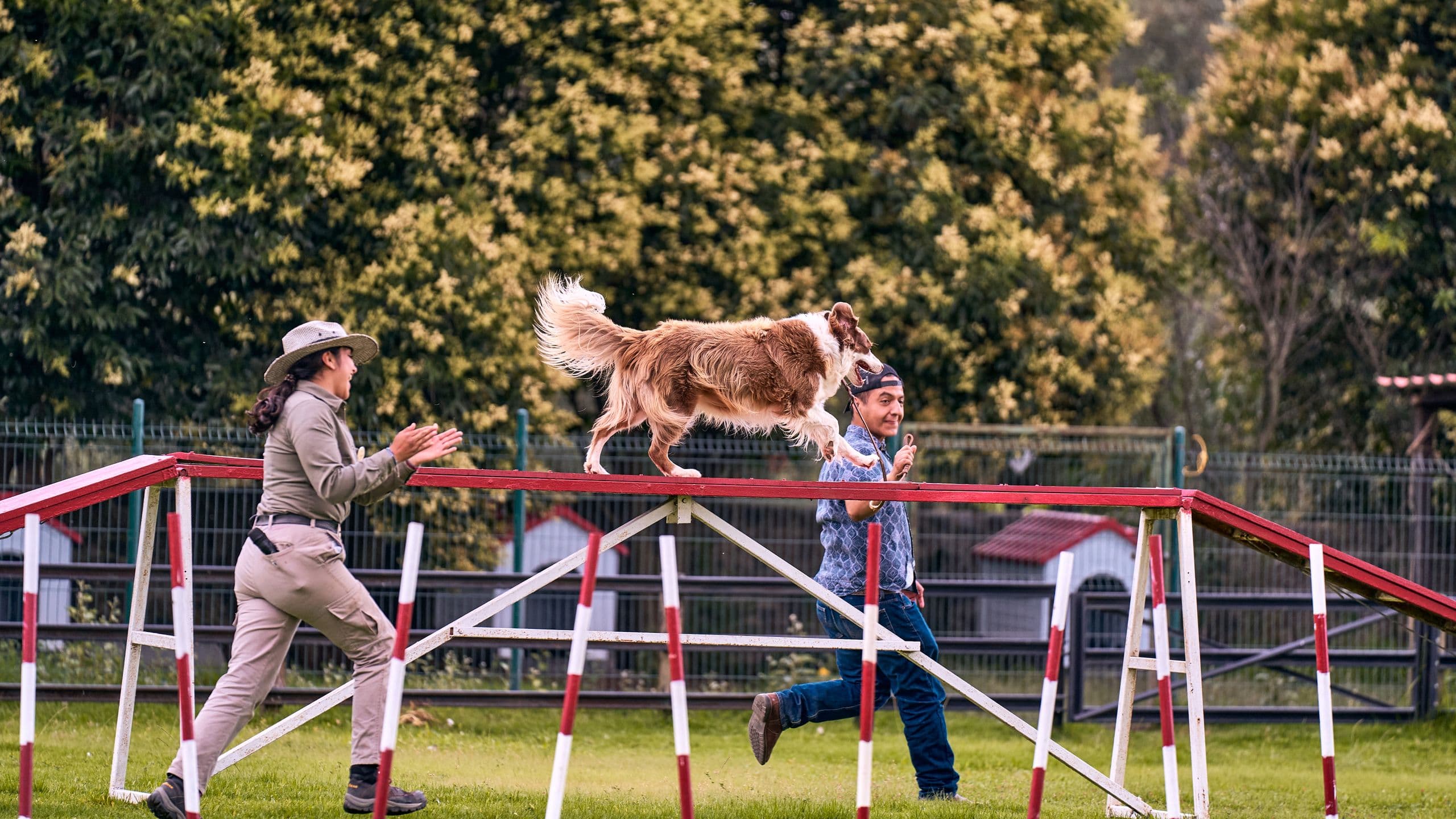
Keep the program with the dog.
Packages, notes and stays on one record — free to run, no contracts, no per-seat pricing.