

Forty dogs in the building and one version of the truth
The morning rush is the whole job. Arrivals stacking up at the desk, someone asking which run Biscuit is in, a phone call about a pickup time, and a dog whose rabies record ran out on night three of a fourteen-night stay.
This is the part of the product that was built first, in a real facility, by people who were losing that morning.
On the dog, not on the person who was told.
The limits, up front.
This is the vertical the platform knows best, which makes it the one where a vague claim would do the most damage. Three things to know before you look further.
Rooms are pools, not named runs
Rooms that share a name are one interchangeable pool, and capacity is the count of active rooms in it. What you call that pool is yours — runs, suites, villas, cabins — and the counting works the same either way. What it won't do is hold a named room: a visit records the pool it occupies, so if you assign Kennel 14 to a specific dog on a specific night, that assignment lives on paper, not here.
There is no offline mode
The board is live because it's connected. If the building's internet goes down, the tablets go with it. Facilities in patchy areas should ask about this rather than find out during a holiday week.
Reports are whole-org, not per-site
Sales and timeclock reports cover the organization. The dashboard and the board filter by location, but the reports don't yet — worth knowing if you're running more than one building.
Five things between 6am and 9am
Everything else on the platform matters eventually. These are the ones that matter before the coffee.
Capacity that counts the right thing
Each room pool has its own count, derived from the rooms that are actually active. A grooming appointment can't silently eat a boarding run, and an overbook is refused at check-in rather than discovered at eight in the evening.
Vaccine shortfalls stopped at the door
Requirements are scoped by species, service and site. A record that lapses partway through a fourteen-night stay is caught — the case an arrival-only check misses entirely — and the manager override is written to the audit log with a name on it.
Deposits and balances settled before the dog is in
An outstanding balance blocks the check-in unless someone with the authority to override says otherwise. The desk stops being the place money quietly goes missing.
Tomorrow's arrivals, already triaged
The households to call — unsigned agreements, lapsed records, unpaid deposits — sit on the dashboard as a worklist for the next seven days, not as a surprise at the door.
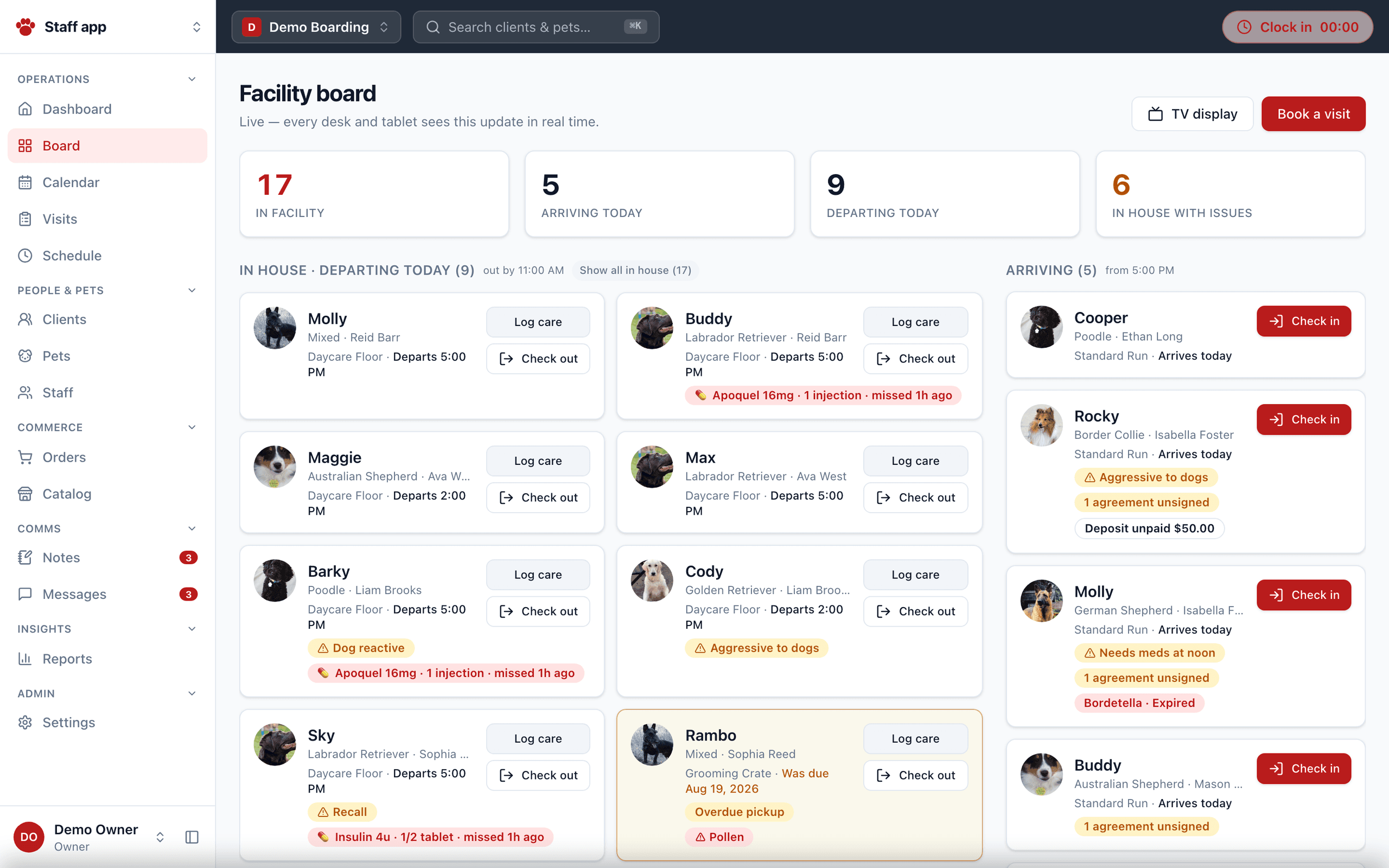
The whiteboard, except it's the same on every screen
Who's in, who's due in, who's going home, and what each of them needs today. Front desk, kennel tablet, the phone in someone's pocket — one live view that updates the second a dog checks in.
- In the building, arrived, and gone home as live counts, not a morning tally
- Feeding and medication flags on the pet rather than in someone's memory
- Pet issues surfaced on the board so nothing waits for a handover conversation
- Filter to one location without leaving the page
Logged in seconds, from where it happened
Feedings, medications, walks, play and incidents, one tap each, timestamped and attributed. The alternative is a clipboard that gets typed up at nine at night by someone guessing.
- Standing medication needs pair to each administration, so a missed dose is flagged
- Photos attach to the pet's timeline as they're taken
- Every entry carries who logged it — the record a difficult conversation needs
The 4pm photo is not a nice-to-have
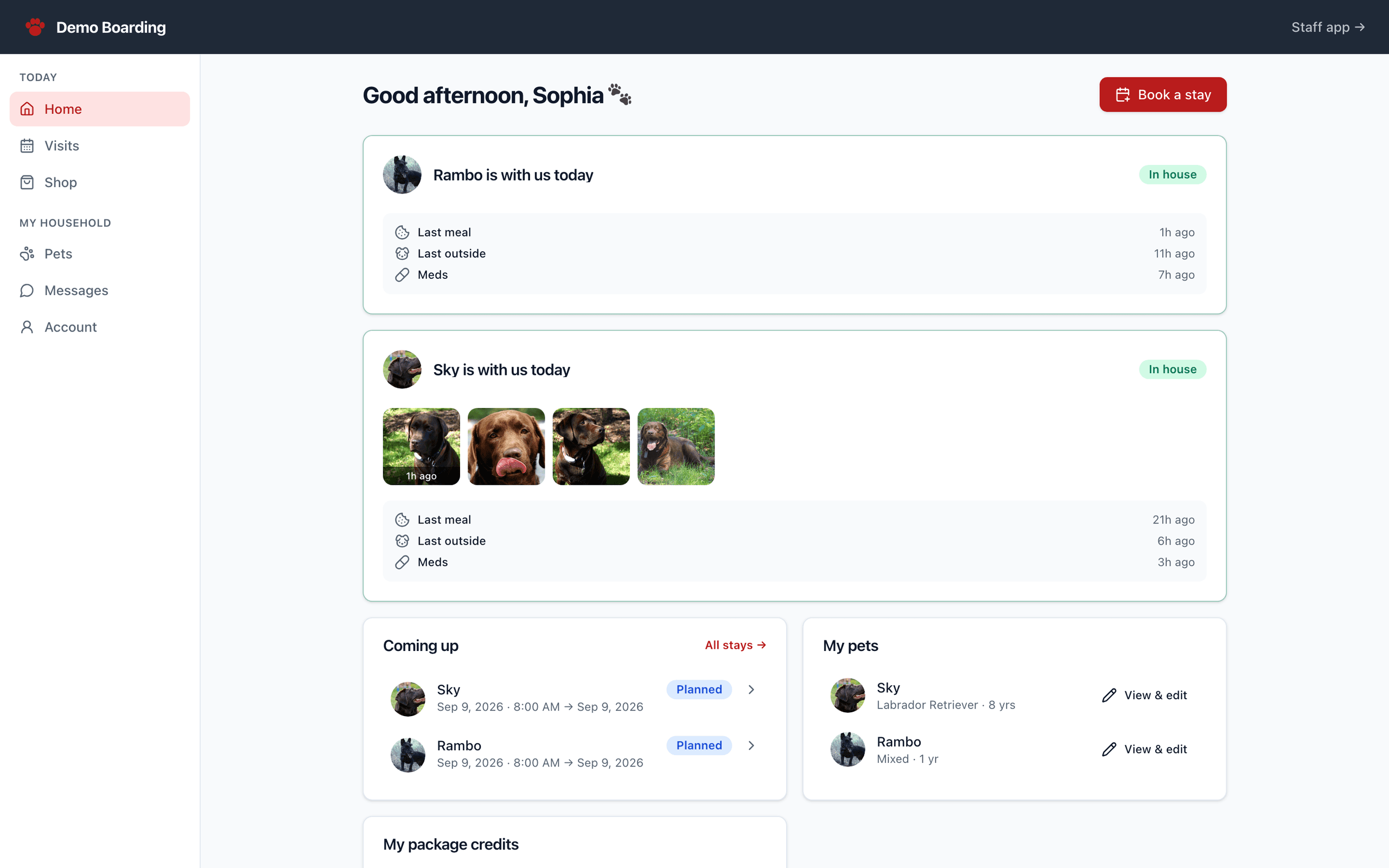
Most of the calls a front desk takes are a version of one question: is my dog alright. Answer it before it's asked and the phone stops ringing.
- Clients book against real availability, 24/7, and sign agreements in the portal
- Last meal, last time out, last medication, visible to the owner while the stay runs
- Photo updates sent from the floor in a tap
What boarding operators ask
How does capacity work over a holiday week?
Capacity is counted per room pool for every night of a stay, so a fourteen-night booking holds its run for all fourteen nights rather than only the night it starts. Overbooking is refused at check-in, with an override for the person whose call it is.
Can we charge different rates by dog size?
Yes. Weight bands carry an additive markup in basis points against the base price, and active bands can't overlap — so a 90lb dog and a 12lb dog on the same service price differently without anyone maintaining two catalogs.
What happens when a vaccine expires mid-stay?
The check-in is refused and the message names which record and which of the two problems it is — already expired, or expiring during the window. A manager can override, and that override is audit-logged rather than whispered across the desk.
Do we have to move all our history over to start?
No. Most facilities go live with clients, pets and forward bookings, and leave the old system readable for historical lookups. Day one looks like a normal day — the only difference is where it gets written down.
What does it cost at our volume?
Nothing per month, at any volume — no per-kennel, per-staff or per-location pricing. Card processing is 3.5% on payments taken through the platform. A facility doing $40,000 a month pays about $1,400 in processing and nothing for the software.
Something not covered here? Ask us directly.
You probably do some of these too
Same platform, same clients, same pets — it doesn't care which service a visit is for. These pages just argue it from a different desk.
Get the morning back.
One board, live capacity, and care logged where it happens — free to run, on as many kennels as you have.